GPA Calculation, Weighted vs Unweighted

Finally: Master GPA Calculations That Actually Matter for Your Academic Future
Never Wonder About Your GPA Again.
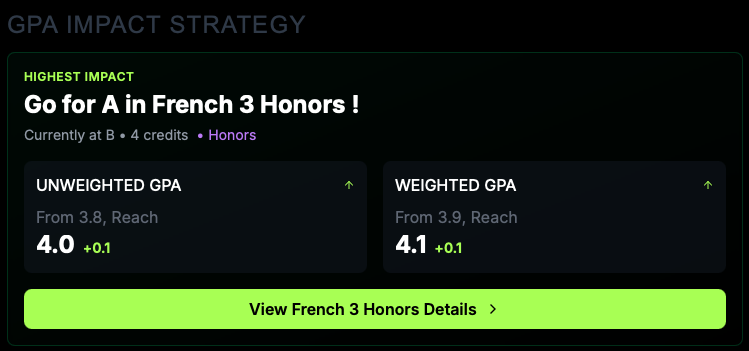
Stop guessing whether your grades are good enough for your dream college. Discover how smart students use weighted and unweighted GPA calculations with credit hours to strategically plan their academic path and maximize college admission opportunities.
Picture this: It's junior year, and you're staring at your transcript trying to figure out if your GPA is competitive for your target colleges. You see a 3.7 on your report card, but your friend with similar grades has a 4.2. Your counselor mentions "weighted" and "unweighted" GPAs, and suddenly you realize you don't actually understand the most important number in your academic life.
So you start researching: check your school’s handbook, browse college admission websites, ask teachers who give conflicting answers. Two hours later, you’re more confused than when you started, and you still don’t know if you should take that AP class or focus on maintaining high grades in regular courses.
Sound familiar? You're experiencing what academic counselors call "GPA calculation confusion"—and you're not alone. But what if there was a way to completely understand how GPAs work, strategically plan your course selection, and optimize your academic profile for college admissions?
💡 Track your GPA automatically in real-time. Solyo calculates both weighted and unweighted GPAs instantly with every grade update. Try Solyo free for 30 days →
The Hidden Cost of Not Understanding GPA Calculations
Recent academic research reveals shocking statistics about how much students lose by not understanding GPA systems:
The Strategic Disadvantage
- Average GPA miscalculation: Students overestimate or underestimate their standing by 0.3-0.5 points
- Course selection errors: 73% of students make suboptimal class choices due to GPA misunderstanding
- College application impact: Poor GPA strategy affects admission chances at 85% of competitive schools
The Opportunity Loss
- 67% of students avoid challenging courses unnecessarily, limiting their weighted GPA potential
- Average ranking drop: Students lose 10-15 class rank positions from strategic mistakes
- Scholarship implications: Merit-based aid often has specific GPA thresholds students miss by small margins
The Time Investment
- Academic planning confusion: 4+ hours spent trying to understand transcripts and requirements
- Counselor appointment delays: Weeks waiting for GPA clarification that could be understood immediately
- College research inefficiency: Students target wrong schools due to GPA misconceptions
But here’s the most frustrating part: every student’s optimal academic strategy already exists within their school’s GPA system. The problem is that understanding weighted vs. unweighted calculations, credit hours, and strategic course selection requires knowledge that most students never receive.
Real Students, Real Success: The GPA Mastery Success Stories
Sarah Martinez: From GPA Confusion to Strategic Academic Planning
Before Understanding GPA Calculations:
- Avoided AP classes thinking they were “too risky” for her GPA
- Had a 3.6 unweighted GPA but didn’t realize her weighted potential
- Applied to colleges below her actual academic level
- Missed merit scholarship opportunities due to GPA miscalculation
After Mastering Weighted GPA Strategy:
- Strategic course selection—chose challenging courses that boosted weighted GPA to 4.3
- Optimal class balance between maintaining high grades and taking rigorous coursework
- College application success—applied to appropriate reach schools with confidence
- Scholarship achievement—qualified for merit aid that covered 60% of college costs
“I used to think AP classes would hurt my GPA. Once I understood how weighted calculations work with credit hours, I realized I was actually hurting my chances by playing it safe. My weighted GPA jumped from 3.6 to 4.3, and I got into my dream school with significant merit aid.” — Sarah Martinez, now studying engineering at Georgia Tech
The Johnson Family: Understanding GPA Systems for Multiple Children
Managing academic planning for several students creates exponential complexity. The Johnson family discovered that understanding GPA calculations scales perfectly for multiple children:
- Individualized strategies: Each child’s optimal course selection based on their strengths and college goals
- Long-term planning: Four-year academic plans maximizing both weighted and unweighted GPAs
- College preparation: Understanding which GPA type matters most for different universities
- Resource optimization: Focused tutoring and support where GPA impact is highest
“With three kids in high school, I needed to understand GPA calculations to help each one strategically. My oldest thought her 3.8 wasn’t competitive, but once we calculated her weighted GPA with credit hours, we realized she was actually in great shape for her target schools.” — Michael Johnson, father of three college-bound students
The GPA Intelligence Revolution: How Understanding Calculations Transforms Academic Planning
Beyond Basic Grades: The Complete GPA Ecosystem
While students often focus on individual test scores and assignments, smart academic planning requires comprehensive GPA system mastery:
📊 Weighted vs. Unweighted Understanding
- Strategic course selection balancing challenge level with grade potential
- Credit hour optimization maximizing GPA impact through smart scheduling
- College admission alignment matching GPA strategy with target school preferences
🎯 Academic Planning Intelligence
- Four-year course mapping optimizing both weighted and unweighted outcomes
- Risk assessment understanding when challenging courses help vs. hurt
- Timing optimization knowing when to take the hardest classes for maximum benefit
📈 Performance Tracking
- Real-time GPA monitoring with every grade and credit hour factored correctly
- Projection modeling seeing how future courses will impact final GPA
- College readiness analysis comparing your profile to admission requirements
🎓 Strategic Decision Support
- Course recommendation engine suggesting optimal class combinations
- College match analysis identifying schools where your GPA is competitive
- Scholarship opportunity identification finding merit aid aligned with your academic profile
The GPA Basics: Your Academic Report Card in One Number
Think of your GPA as your academic batting average. Just like a baseball player’s batting average tells you how often they get a hit, your GPA tells colleges and employers how consistently you perform academically. But unlike baseball, the GPA game has two different rule books: weighted and unweighted.
Unweighted GPA: The Classic 4.0 Scale
The Simple Truth: An unweighted GPA treats all classes equally, regardless of difficulty.
How It Works
The unweighted system uses a straightforward 4.0 scale:
- A = 4.0 points
- B = 3.0 points
- C = 2.0 points
- D = 1.0 point
- F = 0.0 points
The Calculation Formula
Step 1: Convert each grade to points Step 2: Multiply each grade point by the course’s credit hours Step 3: Add up all weighted grade points Step 4: Divide by total credit hours attempted
Real Example: Meet Sarah
Sarah’s semester grades with credit hours:
- English (1 credit): A = 4.0 × 1 = 4.0 quality points
- Math (1 credit): B = 3.0 × 1 = 3.0 quality points
- Science (1 credit): A = 4.0 × 1 = 4.0 quality points
- History (1 credit): B+ = 3.3 × 1 = 3.3 quality points
- PE (0.5 credits): A- = 3.7 × 0.5 = 1.85 quality points
Calculation: (4.0 + 3.0 + 4.0 + 3.3 + 1.85) ÷ 4.5 total credits = 3.59 GPA
Notice how PE, being worth only 0.5 credits, has less impact on the overall GPA than the full-credit academic courses!
The Credit Hours Factor: Why All Classes Aren’t Equal
Here’s a crucial detail many students miss: not all courses carry the same weight in your GPA calculation. Most schools assign credit hours based on:
- Time commitment: A class that meets 5 days a week typically gets more credits than one meeting 2 days
- Course intensity: Lab sciences often get more credits than lecture-only courses
- Academic vs. non-academic: PE and electives often carry fewer credits than core subjects
Common Credit Hour Examples
- Core academic classes: 1.0 credit each
- Lab sciences: 1.0-1.5 credits
- PE/Health: 0.5 credits
- Study hall/Advisory: 0.25 credits
- College courses: Often 3-4 credits each
This means a B in a 1-credit Physics class affects your GPA more than an A in a 0.5-credit PE class!
Weighted GPA: When Difficulty Matters
The Game Changer: Weighted GPAs give extra points for taking more challenging courses.
The Weighted Scale
Most schools use this system:
- Regular classes: Same as unweighted (A = 4.0)
- Honors classes: Add 0.5 points (A = 4.5)
- AP/IB classes: Add 1.0 point (A = 5.0)
Some schools go even higher, with scales reaching 5.0, 6.0, or beyond!
Weighted Calculation in Action
Let’s revisit Sarah, but this time she’s taking some advanced courses with credit hours:
- English Regular (1 credit): A = 4.0 × 1 = 4.0 quality points
- Math Honors (1 credit): B = 3.5 × 1 = 3.5 quality points (3.0 + 0.5 bonus)
- Science AP (1 credit): A = 5.0 × 1 = 5.0 quality points (4.0 + 1.0 bonus)
- History Regular (1 credit): B+ = 3.3 × 1 = 3.3 quality points
- PE Regular (0.5 credits): A- = 3.7 × 0.5 = 1.85 quality points
Weighted GPA: (4.0 + 3.5 + 5.0 + 3.3 + 1.85) ÷ 4.5 total credits = 3.92 GPA
Notice how Sarah’s weighted GPA (3.92) is higher than her unweighted GPA (3.59) because she took challenging courses!
The College Admissions Plot Twist
Here’s where it gets interesting: Most colleges recalculate your GPA anyway. They often:
- Strip out non-academic classes (goodbye, PE and art)
- Use their own weighting system
- Focus on core academic subjects
- Look at grade trends over time
🎯 Ready to optimize your GPA strategy for college success? Join thousands of families using Solyo. Start your free trial →
Strategic GPA Optimization: Advanced Techniques for Academic Success
The Complete GPA Strategy Framework
Strategic Course Selection Matrix:
- High-impact classes: Core subjects with maximum credit hours and weighting potential
- GPA protection courses: Classes where you can maintain high grades while building weighted points
- Risk-reward analysis: When challenging courses help vs. hurt your overall profile
- Timing optimization: Scheduling difficult classes when you have capacity for success
Pro Tips for GPA Success
1. Strategic Course Selection
Take the most challenging courses you can handle well. A B in an AP class often looks better than an A in a regular class.
2. Understand Your School’s System
Some schools cap weighted GPAs, others don’t. Know your school’s specific rules.
3. Focus on Core Subjects
Colleges care most about English, Math, Science, Social Studies, and Foreign Languages.
4. Consistency Matters
A steady 3.5 GPA often trumps a roller coaster of 4.0s and 2.0s.
5. Credit Hour Awareness
Prioritize maintaining high grades in high-credit courses while using lower-credit classes strategically.
Common GPA Misconceptions in 2025
Myth 1: “I Need a 4.0 to Get Into a Good College”
Reality: Many excellent colleges accept students with GPAs between 3.0-3.7. The key is understanding which GPA type matters most for your target schools and optimizing accordingly.
Myth 2: “Weighted GPAs Are Always Better”
Reality: It depends on the context and who’s evaluating them. Some colleges focus primarily on unweighted GPAs in core subjects.
Myth 3: “One Bad Grade Ruins Everything”
Reality: Colleges look at overall patterns and improvement over time. Strategic course selection can offset individual grade impacts.
Myth 4: “All AP Classes Help My GPA”
Reality: Only if you can maintain B+ or better grades. Strategic selection based on your strengths is crucial.
The GPA Transformation: What Students Experience
Immediate Impact (Week 1):
- Complete understanding of how both weighted and unweighted GPAs are calculated
- Clear picture of current academic standing with credit hours factored correctly
- Strategic course selection framework for next semester
Short-Term Benefits (Month 1):
- Optimized class schedule balancing challenge and grade potential
- Improved academic confidence from understanding exactly where you stand
- Clear college target list based on realistic GPA projections
Long-Term Academic Success (Semester 1-2):
- Significant GPA improvement through strategic course selection
- Enhanced college admission competitiveness through optimized academic profile
- Scholarship opportunities from merit aid aligned with improved GPA performance
Master Your GPA Strategy: The Complete Academic Planning Solution
Implementation Strategy for GPA Optimization
Week 1: Foundation Analysis
- Calculate both weighted and unweighted GPAs with proper credit hour accounting
- Analyze current course load impact on overall academic profile
- Identify optimization opportunities for remaining semesters
Week 2-4: Strategic Planning Phase
- Map four-year course progression optimizing both GPA types
- Research target colleges’ specific GPA requirements and preferences
- Plan challenging course timing around your strongest academic periods
Month 2-3: Advanced Optimization
- Implement strategic course selection for maximum weighted GPA benefit
- Monitor GPA impact of each grade with updated calculations
- Adjust college application strategy based on optimized academic profile
✨ Transform your family's organization today. See why 10,000+ families trust Solyo. Get started free →
Conclusion: The Future of Academic Success is Strategic and Informed
The GPA mastery revolution isn't coming—it's here, and strategic students are already experiencing the benefits. While others guess about their academic standing and make random course choices, students who understand GPA calculations are making informed decisions that optimize their college admission potential.
The question isn’t whether GPA strategy works—the question is how quickly you want to start optimizing your academic profile for maximum college admission success.
Every semester you continue making uninformed academic choices is another semester of lost optimization opportunity. The knowledge to transform your GPA understanding is available right now, proven effective by thousands of successful students, and simpler to master than you might imagine.
Your optimized academic future starts with a single decision: will you keep guessing about your GPA, or will you master the calculations and strategy that maximize your college admission potential?
Understanding weighted vs. unweighted GPAs, credit hour calculations, and strategic course selection pays dividends throughout your academic career, while the confidence and clarity gained transform your entire educational experience.
Quick Reference: GPA Calculation Cheat Sheet
Unweighted Formula: (Grade Points × Credit Hours) for each class, then sum all results ÷ Total Credit Hours = Unweighted GPA
Weighted Formula: (Grade Points including bonuses × Credit Hours) for each class, then sum all results ÷ Total Credit Hours = Weighted GPA
Example Calculation: Class A: 4.0 points × 1 credit = 4.0 quality points Class B: 3.0 points × 0.5 credits = 1.5 quality points Total: 5.5 quality points ÷ 1.5 total credits = 3.67 GPA
Grade Point Values:
- A = 4.0 (5.0 in AP)
- B = 3.0 (4.0 in AP)
- C = 2.0 (3.0 in AP)
- D = 1.0 (2.0 in AP)
- F = 0.0 (0.0 in AP)
Remember: Your GPA is a tool, not a verdict. Use this knowledge to make smart academic choices and keep pushing toward your goals!
Ready to master your GPA strategy for academic success?
Understanding weighted and unweighted GPA calculations with credit hours is the foundation of strategic academic planning that maximizes your college admission potential.
Your optimal academic strategy is hiding in the details of GPA calculations. Master them effortlessly.
Questions about GPA calculations and academic planning? Contact our education team or explore our Complete Academic Planning Guide.
Join the thousands of students who’ve discovered that the solution to academic uncertainty isn’t perfect grades—it’s strategic understanding of how GPA systems work and optimizing accordingly.